Press Release Writing: What Brands Must Get Right
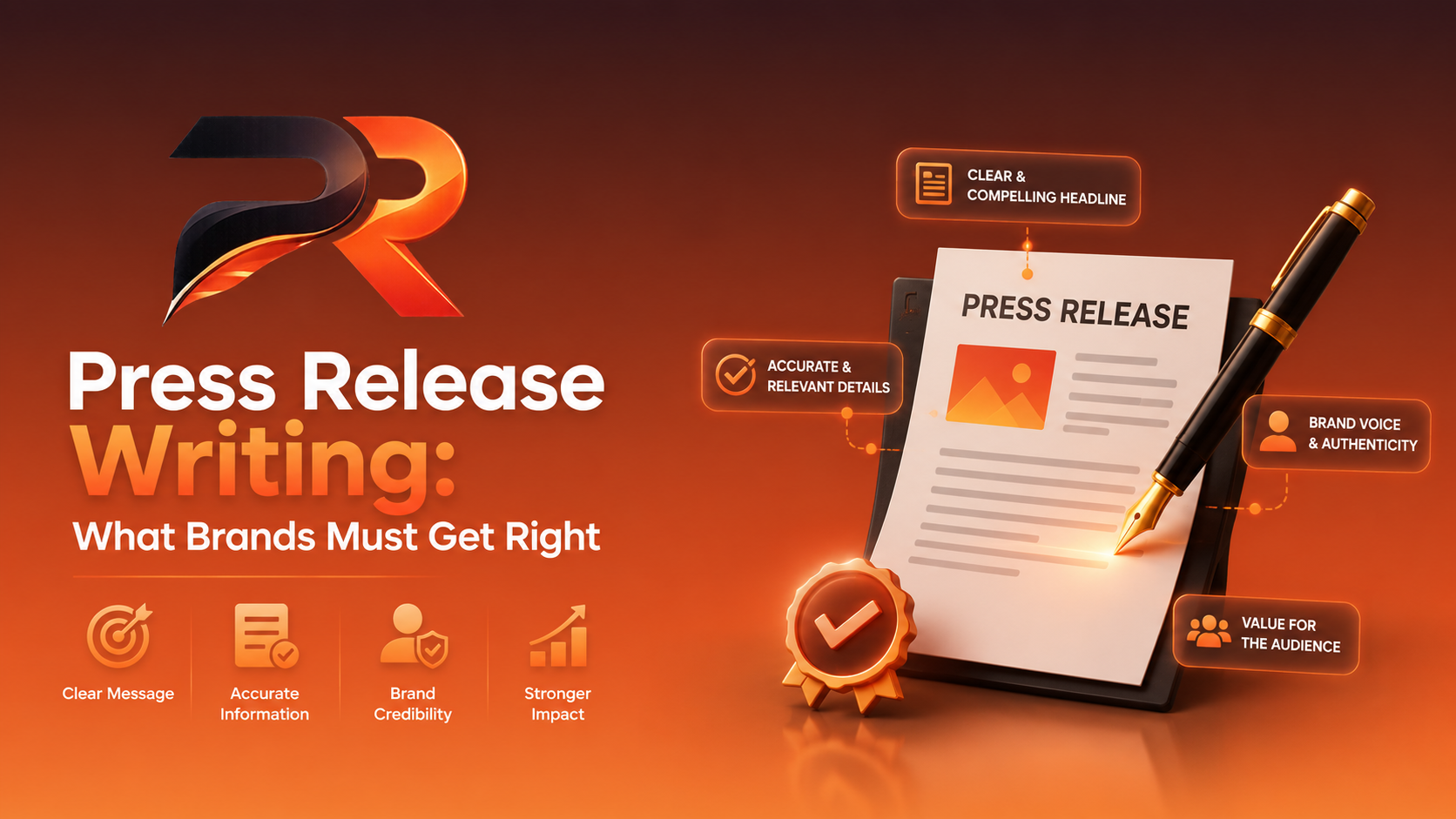
Press Release Writing: What Brands Must Get Right
If you want media coverage, credibility, better search visibility, and investor-ready brand authority, your press release cannot read like an ad. It has to read like news.
That is where many brands fail. Startups rush out product launch announcements with no clear angle. Small businesses overload releases with hype. Marketing teams send generic copy to journalists who instantly ignore it. And growing brands often assume distribution alone will solve weak messaging. It will not.
Strong press release writing is a mix of strategy, journalism, formatting, positioning, and timing. The best releases do three things at once: they make the story easy for journalists to use, they make the brand look credible, and they create measurable business value through visibility, backlinks, and trust.
For founders, entrepreneurs, and companies that need fast exposure without hiring a traditional PR agency, this is exactly why expert support matters. PR Publishing helps brands move faster with professional press release writing by experienced writers, guaranteed publication on high-authority news websites, transparent pricing, fast turnaround in 24–72 hours, and live links reporting that proves where your story appeared. That combination of speed, clarity, and accountability is what turns PR into a growth channel instead of a guessing game.
87% of journalists favor email for receiving pitches.” – MarketingProfs
“Press releases featuring a photo received 1.8 times more views than text-only releases.” – PR Newswire
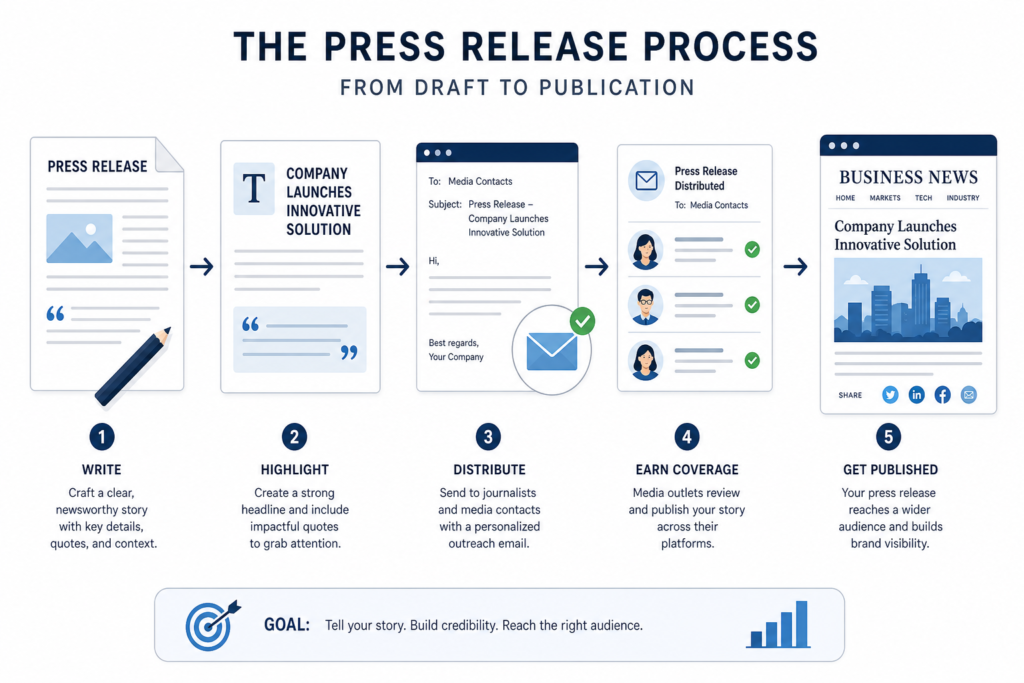
What press release writing actually means
At its core, a press release is a structured news announcement written for media use. It is not a brochure, a sales page, or a founder’s opinion piece.
Effective press release content writing should help an editor, reporter, publisher, or syndication platform quickly answer:
- What happened?
- Why does it matter now?
- Who does it affect?
- What makes this newsworthy?
- Can this be published with minimal rewriting?
That last point is crucial. Journalists and editors work under time pressure. If your release is unclear, self-promotional, vague, or badly formatted, it gets skipped. Great releases reduce friction. They are concise, relevant, factual, and easy to lift into an article.
What top-ranking advice gets right – and what brands still miss
Across leading guidance on press release writing, several winning themes show up consistently:
- Start with a strong, specific headline
- Lead with the most important facts
- Use the 5 Ws early
- Keep the release concise
- Follow AP-style conventions
- Include quotes, contact details, and a boilerplate
- Match the story to the right media audience
All of that is correct. But there are important content gaps many articles gloss over.
Content gaps most brands need to understand
1. Newsworthiness comes before writing quality
A beautifully written release with no real story still fails. Many articles explain structure but not story selection. Before drafting anything, ask whether the announcement has actual media value.
2. Distribution does not fix weak messaging
Even broad media distribution cannot rescue a release with no hook, unclear benefits, or no audience relevance. Writing and placement must work together.
3. SEO value matters more than ever
Most generic guides underplay the importance of releases for branded search, trust signals, backlinks, and authority. When press releases are published on reputable sites and supported with guest posts, they can strengthen your entire online presence.
4. Speed and proof are business-critical
Brands do not just want “exposure.” They want a reliable system. Fast turnaround, transparent pricing, revision support, and live publication links matter because they reduce risk.
5. Professional writers change outcomes
There is a major difference between a release written by a marketer and one written by an experienced journalist-style writer. Skilled press release writers know how to create usable media copy instead of branded fluff.
What makes a press release genuinely newsworthy
A press release should announce something that gives the market, community, customers, or media a reason to care now.
Common examples of strong news angles
- Product launch with clear market relevance
- Funding round or investor milestone
- Major partnership
- Expansion into a new region or market
- Executive appointment with strategic importance
- New research, survey, or report
- Award with strong credibility
- Crisis response or public statement
- Event announcement with public impact
- Acquisition, merger, or rebrand
Weak angles that usually fail
- Generic “we are excited” announcements
- Minor website redesigns with no larger significance
- Vague service updates
- Empty brand milestones with no public value
- Promotional copy disguised as news
A simple test: if a journalist asked, “Why should our audience care?” could you answer in one sentence? If not, the story angle is not ready.
The press release writing style that gets picked up
Good press release writing style is direct, factual, and newsroom-friendly. It avoids hype and respects the reader’s time.
What strong style looks like
- Clear headline with real meaning
- Active voice
- Short paragraphs
- Concrete details over vague claims
- Neutral, credible wording
- Immediate relevance in the first paragraph
- Quotes that add insight, not repetition
What weak style looks like
- Overuse of words like “innovative,” “revolutionary,” and “cutting-edge”
- Long, cluttered introductions
- Excessive company self-praise
- Jargon with no explanation
- Hidden news angle
- Quotes that say nothing
- Attachment-heavy outreach with no clean copy in the email body

The core structure every press release should follow
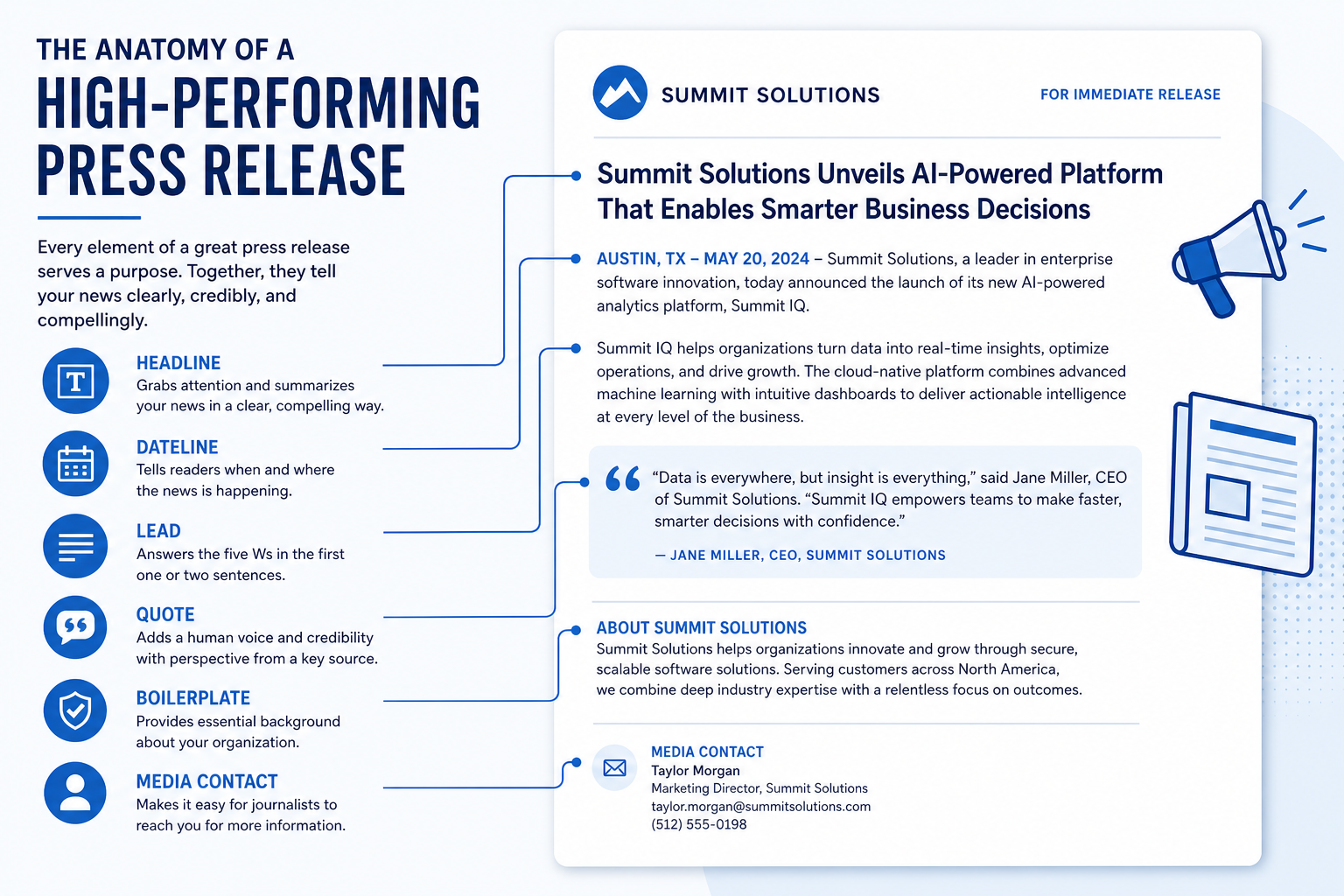
A high-performing release should be easy to scan and easy to publish. The classic inverted pyramid still works because it prioritizes the most important information first.
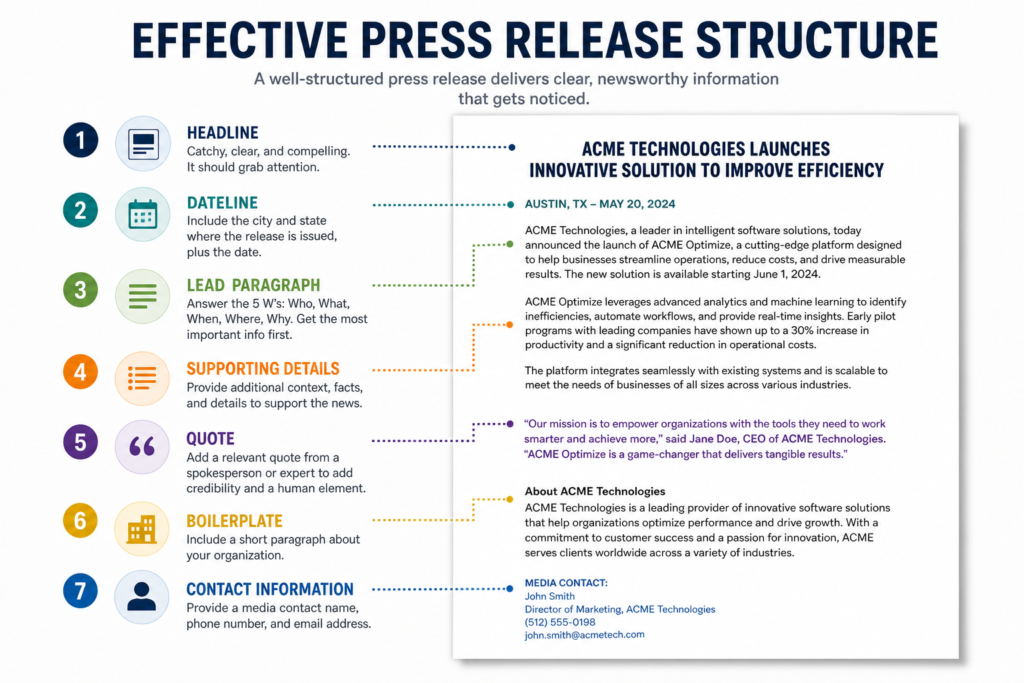
Recommended press release structure
| Section | What it should do | Best practice |
|---|---|---|
| Headline | Communicate the news fast | Be specific, concise, and relevant |
| Dateline | Establish place and timing | Use standard media format |
| Lead paragraph | Cover who, what, when, where, why | Keep it tight and factual |
| Body | Add context, proof, and details | Use short paragraphs and supporting data |
| Quote | Add perspective or authority | Make it human and meaningful |
| Boilerplate | Explain the company briefly | Keep it concise and credible |
| Media contact | Make follow-up easy | Include name, email, phone |
Ideal length
Most strong press releases land around 300 to 700 words. Short enough to stay focused, long enough to provide substance.
The 5 elements brands must get right every time
1. The headline
The headline decides whether anyone reads further. It should communicate the story, not try to sound clever for its own sake.
Better headline example:
Startup Secures $5M to Expand AI Hiring Platform Across Europe
Weaker headline example:
A Revolutionary Step Forward in Talent Innovation
The better version is concrete, timely, and informative.
2. The lead paragraph
The first paragraph should answer the key facts immediately. Do not bury the announcement under company background.
A strong lead gives the editor enough information to understand the story in seconds.
3. The quote
A quote should add perspective, intent, or significance. It should not repeat the headline in a slightly different form.
Bad quote:
“We are thrilled to announce this exciting new milestone.”
Better quote:
“This expansion gives mid-market manufacturers access to deployment support in under 14 days, which removes one of the main barriers to adoption.”
4. The proof
Facts make releases believable. Include specifics such as:
- Funding amount
- Market expansion details
- User growth
- Survey data
- Launch dates
- Strategic partners
- Performance results
5. The close
Finish with a clean boilerplate and clear contact details. If media cannot reach the right person quickly, you lose momentum.
Common press release mistakes that kill coverage
The most frustrating thing for editors is not bad grammar. It is wasted time.
Biggest mistakes brands make
- Writing subject lines that hide the story
- Sending irrelevant pitches to the wrong journalists
- Opening with boilerplate instead of news
- Using all caps or fake urgency
- Attaching large files unnecessarily
- Forgetting to explain what the company actually does
- Using buzzwords like “solution” with no substance
- Omitting data sources or sample sizes
- Following up too quickly or too aggressively
- Making the release sound like an ad
A practical rule
If your release feels self-serving, bloated, or hard to summarize, it probably needs rewriting.
Press release content writing for different business goals
Not every release should be written the same way. The angle should match the business objective.
For startups seeking credibility
Focus on traction, product-market fit, funding, partnerships, and founder credibility. The goal is to build legitimacy quickly.
For small businesses building visibility
Emphasize local relevance, community impact, differentiation, and timely milestones.
For established brands
Use releases to shape narrative, protect reputation, support launches, and maintain authority across search and media.
For SEO and digital marketing teams
A release can support branded search, referral traffic, reputation management, and authority building when paired with publication placements and backlinks.
This is one reason brands choose PR Publishing. Instead of stopping at writing alone, the service combines expert press release writing, broad media distribution, guaranteed publication on reputable news sites, and SEO-enhancing guest posts and backlinks. That gives companies both media exposure and search value in one coordinated campaign.
When to use press release writing services
There are situations where doing it yourself may be fine, and situations where professional help is the smarter move.
You may be able to write it in-house if
- The announcement is simple
- Your team understands media style
- You already know the target outlets
- Stakes are relatively low
You should consider professional press release writing services if
- The announcement affects brand reputation
- You need publication quickly
- You want guaranteed placement
- Your internal team lacks newsroom writing experience
- You need help shaping the angle
- SEO and authority matter as much as coverage
- You want scalable PR without hiring a full agency
For many growing companies, the real value is not just writing. It is getting the story written properly, distributed strategically, published on authoritative sites, and reported back with live links.
DIY vs expert press release writers
| Factor | DIY Writing | Expert Press Release Writers |
|---|---|---|
| Story angle | Often unclear or too internal | Built around media relevance |
| Tone | Promotional or inconsistent | Journalistic and credible |
| Speed | Depends on internal bandwidth | Often 24–72 hours |
| Formatting | Easy to get wrong | Professionally structured |
| Distribution | Manual and uncertain | Access to media network |
| Publication outcome | No guarantees | Can include guaranteed placements |
| SEO value | Often limited | Stronger when paired with backlinks and guest posts |
| Transparency | Hard to measure | Live links and reporting available |
This is where PR Publishing stands out. Brands get fast turnaround, transparent package pricing, revision support, and a full refund guarantee if publication promises are not met. That combination dramatically lowers the risk of investing in PR.
How to choose the right press release writing services
Not all providers offer the same level of writing quality, placement access, or accountability.
What to look for
Proven writing quality
Ask whether the release is written by experienced professionals who understand media style, not just SEO copywriters.
Real publication network
A provider should have access to reputable publications, not vague claims about “distribution.”
Clear turnaround times
If timing matters, you need reliable delivery windows.
Transparent pricing
Avoid hidden fees, surprise upsells, and unclear syndication promises.
Reporting and proof
You should receive live publication links and clear evidence of delivery.
Revision support
Good services refine the message until it is ready.
Satisfaction guarantee
A serious provider stands behind its publishing commitments.
PR Publishing aligns well on all of these points: guaranteed publication on high-authority news websites, expert writing, scalable packages for startups through enterprises, no hidden fees, live links reporting, and a refund guarantee if commitments are not met.
A practical press release checklist before you publish
Use this checklist before any release goes live.
Story and strategy
- Is the story actually newsworthy?
- Is the audience clear?
- Is the angle relevant now?
- Does it support a business objective?
Writing quality
- Does the headline state the news?
- Does the first paragraph answer the main questions?
- Are claims supported by facts?
- Does the quote add value?
- Is the tone credible and clean?
Formatting and distribution
- Is the dateline correct?
- Are contact details complete?
- Is the boilerplate concise?
- Are images or assets ready?
- Is the release tailored to the right media targets?
Why multimedia and distribution strategy matter
A press release is not only a writing exercise. It is a publishing asset.
Multimedia increases engagement
Images, charts, videos, and founder headshots can improve performance because they make the release easier to use and more engaging to readers.
Distribution determines visibility
The best-written release in the world cannot help if nobody credible sees it. Strong distribution means:
- Relevant media targeting
- Proper timing
- Publication network access
- SEO-minded placement strategy
- Follow-up readiness
For brands that need speed and certainty, PR Publishing simplifies this process. Instead of chasing editors blindly, clients get a streamlined path from business details to professionally written release to publication on trusted media outlets, with measurable reporting and live links at the end.
How press releases support SEO and online credibility
This is another area many brands underestimate.
A press release published on quality news and media sites can strengthen your online footprint in several ways:
- More branded search visibility
- Better trust signals for customers and investors
- Referral traffic from media placements
- Stronger backlink profile when combined with guest posting
- Improved authority across search results
- More proof points for sales conversations and fundraising decks
Press releases should not be your only SEO tactic, but they can be a powerful credibility layer. When integrated with digital PR and guest posting, they help brands look established long before they become household names.
A simple framework for writing a stronger press release
If you want a reliable formula, use this:
Step 1: Define the news angle
What is the actual announcement, and why does it matter now?
Step 2: Identify the audience
Who needs to care about this story most: investors, customers, local media, trade press, partners, or prospects?
Step 3: Lead with facts
Put the core announcement in the first paragraph.
Step 4: Add proof
Use numbers, dates, specifics, and context.
Step 5: Add one strong quote
Use a quote that explains significance or next steps.
Step 6: Close cleanly
Include a short boilerplate and direct media contact.
Step 7: Publish strategically
Distribute where it can produce trust, reach, and SEO value.
Final verdict
Great press release writing is not about sounding impressive. It is about being useful, credible, and publishable.
Brands must get the fundamentals right: a real story, a sharp angle, journalist-friendly formatting, concise writing, proof-backed claims, and smart distribution. Miss those basics, and even a polished release gets ignored. Get them right, and a press release becomes a high-leverage asset for media coverage, reputation, SEO, and growth.
For companies that want faster results with less risk, PR Publishing offers a practical advantage. You get expert press release writers, fast 24–72 hour turnaround, guaranteed publication on high-authority news websites, transparent pricing, live links reporting, SEO value through backlinks and guest posts, and a refund guarantee if promised publishing outcomes are not delivered.
If your brand needs credible exposure without the friction of traditional PR, PR Publishing is the scalable solution built for startups, founders, marketing teams, and growth-focused businesses that need results now.
FAQ
What not to include in a press release?
Do not include hype-heavy marketing language, vague buzzwords, irrelevant company history, unsupported claims, or oversized attachments that slow journalists down. A press release should focus on real news, clear facts, and audience relevance.
What are three qualities of a good press release?
A good press release is newsworthy, concise, and credible. It should lead with the key facts, use a clear journalistic structure, and include proof or context that makes the story easy to publish.
What are the 5 W’s of journalism?
The 5 W’s are Who, What, When, Where, and Why. In press release writing, these should appear early so editors and readers can understand the story immediately.
What is ABCD in journalism?
In practical media writing, ABCD often refers to keeping communication Accurate, Brief, Clear, and Direct. Those principles align closely with effective press release writing style and help make a story easier for journalists to use.