Press Release: What It Is and Why It Matters
Press Release: What It Is and Why It Matters
If you are launching a startup, announcing a new product, entering a new market, raising funding, hiring a major executive, or trying to build brand credibility fast, you have likely come across the term press release. You may also have seen variations like press release news release, press release news, or industry-specific phrases such as IT press release. They are closely related, but they are not always used with the same intent.
At its core, a press release is one of the fastest ways to turn a business update into something the media, search engines, investors, customers, and partners can actually see and trust. Done correctly, it can increase visibility, strengthen brand authority, support SEO, and create immediate proof that your company is active and credible.
For founders and growing brands, the challenge is rarely understanding that publicity matters. The real challenge is getting published quickly, professionally, and without wasting time on traditional PR gatekeeping. That is exactly where a done-for-you service like PR Publishing becomes valuable: expert press release writing, guaranteed publication on high-authority news websites, fast turnaround often within 24–72 hours, transparent pricing, live link reporting, and a refund guarantee if publishing commitments are not met.
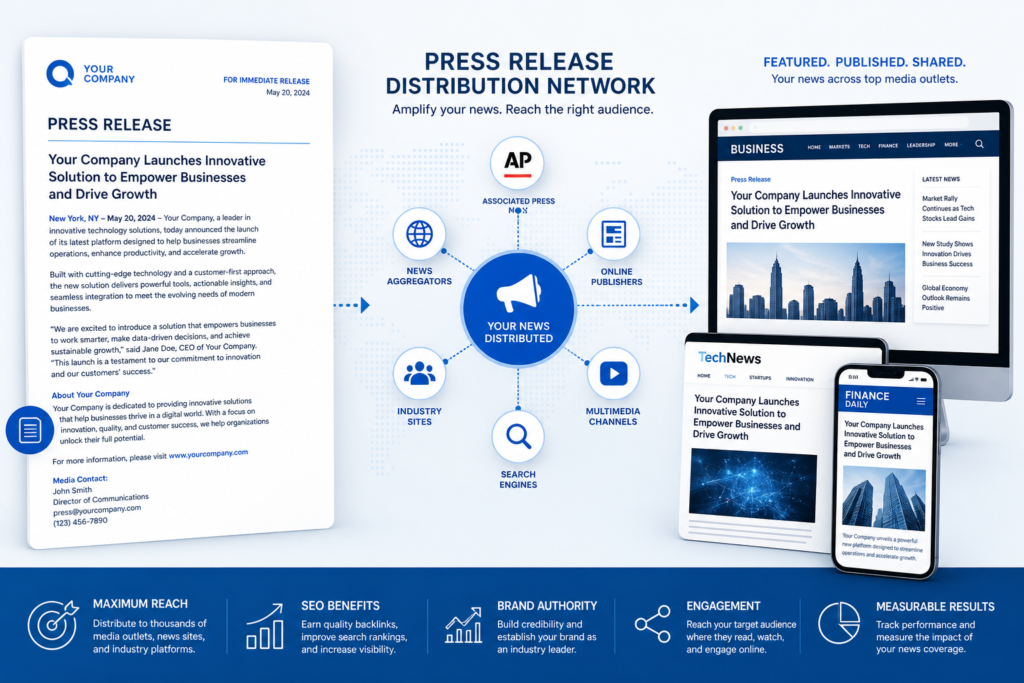
Press Release: What It Is and Why It Matters
If you are launching a startup, announcing a new product, entering a new market, raising funding, hiring a major executive, or trying to build brand credibility fast, you have likely come across the term press release. You may also have seen variations like press release news release, press release news, or industry-specific phrases such as IT press release. They are closely related, but they are not always used with the same intent.
At its core, a press release is one of the fastest ways to turn a business update into something the media, search engines, investors, customers, and partners can actually see and trust. Done correctly, it can increase visibility, strengthen brand authority, support SEO, and create immediate proof that your company is active and credible.
For founders and growing brands, the challenge is rarely understanding that publicity matters. The real challenge is getting published quickly, professionally, and without wasting time on traditional PR gatekeeping. That is exactly where a done-for-you service like PR Publishing becomes valuable: expert press release writing, guaranteed publication on high-authority news websites, fast turnaround often within 24–72 hours, transparent pricing, live link reporting, and a refund guarantee if publishing commitments are not met.
What Is a Press Release?
A press release is a short, structured, factual announcement created by a business, organization, or individual to share news with the media and the public. Its purpose is to communicate something newsworthy clearly and efficiently.
Common examples include:
- product launches
- funding announcements
- mergers and acquisitions
- executive appointments
- event announcements
- partnerships
- awards and milestones
- crisis responses
- charity initiatives
- company expansion updates
A press release is not just an advertisement. It is written in a journalistic style so it can be easily understood, quoted, republished, or turned into a story.
Press Release vs News Release
Many people ask whether press release and news release mean different things.
In practical use, they are usually the same thing. The phrase press release news release appears in search because people use both terms interchangeably. Historically, “press release” was tied more directly to newspapers and journalists, while “news release” became a broader term as digital publishing expanded. Today, most businesses, marketers, and publishers treat them as synonyms.
What Does “Press Release News” Mean?
The keyword press release news usually refers to one of two things:
- a newsworthy announcement published in press release format
- a distributed release that appears on news websites, media portals, or syndication networks
That second meaning matters a lot for businesses. A press release that stays in a Google Doc has no market value. A press release that gets published on recognizable media sites can improve visibility, credibility, branded search results, and sometimes even referral traffic.
Why Press Releases Still Matter
Some businesses assume press releases are outdated because social media and content marketing exist. That is a mistake. Press releases still matter because they do something social posts often cannot: they create a formal, credible, reusable record of company news.
“72% of journalists consider press releases the most useful resource PR teams can offer.” – Source
“82% of consumers consider trust a decisive factor when making purchases.” – Source
Those two realities connect directly: journalists want clear source material, and buyers want brands they trust. A strong press release helps with both.
The Business Value of a Press Release
A professionally written and distributed press release can help you:
- establish legitimacy
- create third-party visibility
- support investor confidence
- improve online reputation
- strengthen branded search presence
- generate backlinks through guest posts and digital PR
- give sales teams proof points to share
- create authority around product launches and milestones
- control the narrative during sensitive situations
For startups and small businesses, this matters even more. Early-stage brands often struggle because they have real momentum but little public proof. A published press release bridges that gap.
The Main Purpose of a Press Release
A press release should answer one question:
Why should anyone care right now?
That means it must do more than announce information. It must frame the update in a way that makes it relevant to journalists, customers, partners, investors, or search audiences.
A Good Press Release Helps You:
| Goal | How a Press Release Supports It |
|---|---|
| Brand credibility | Creates visible, formal proof of company activity |
| Media exposure | Gives journalists a ready-made factual source |
| SEO value | Supports branded search, entity signals, and linked content assets |
| Investor confidence | Shows traction, progress, and public legitimacy |
| Sales enablement | Gives prospects something objective to read |
| Reputation management | Lets you communicate your version of the facts clearly |
When You Should Use a Press Release
Not every update deserves a release. The best press releases are tied to something that is timely, relevant, and meaningful.
Strong Use Cases
Use a press release when you have:
- launched a new company, product, or service
- raised funding
- signed a strategic partnership
- expanded into a new market
- opened a new office or facility
- hired a high-profile executive
- won an award
- released new research or data
- announced an event or conference appearance
- responded to an issue that affects public trust
Weak Use Cases
A press release is usually unnecessary for:
- vague motivational brand statements
- internal updates with no public relevance
- overly promotional discount offers
- minor changes with no broader business impact
This is one of the biggest content gaps in many beginner guides: they explain format, but not selection. The truth is simple – distribution only works well when the story is worth distributing.
The 5 W’s and 1 H of a Press Release
A strong release answers the classic journalism questions:
- Who is involved?
- What happened?
- Where is it happening?
- When is it happening?
- Why does it matter?
- How did it happen or how does it work?
These questions are not optional. They are the foundation of clarity.
Example
If a cybersecurity startup launches a new AI threat monitoring platform:
- Who: the startup and its leadership
- What: launch of a new platform
- Where: available in the U.S. and Europe
- When: effective immediately or on a launch date
- Why: helps enterprises detect threats faster
- How: through machine learning, 24/7 monitoring, and cloud integration
The Standard Press Release Format
Most high-performing press releases follow a familiar structure because it makes them easy to scan, understand, and publish.
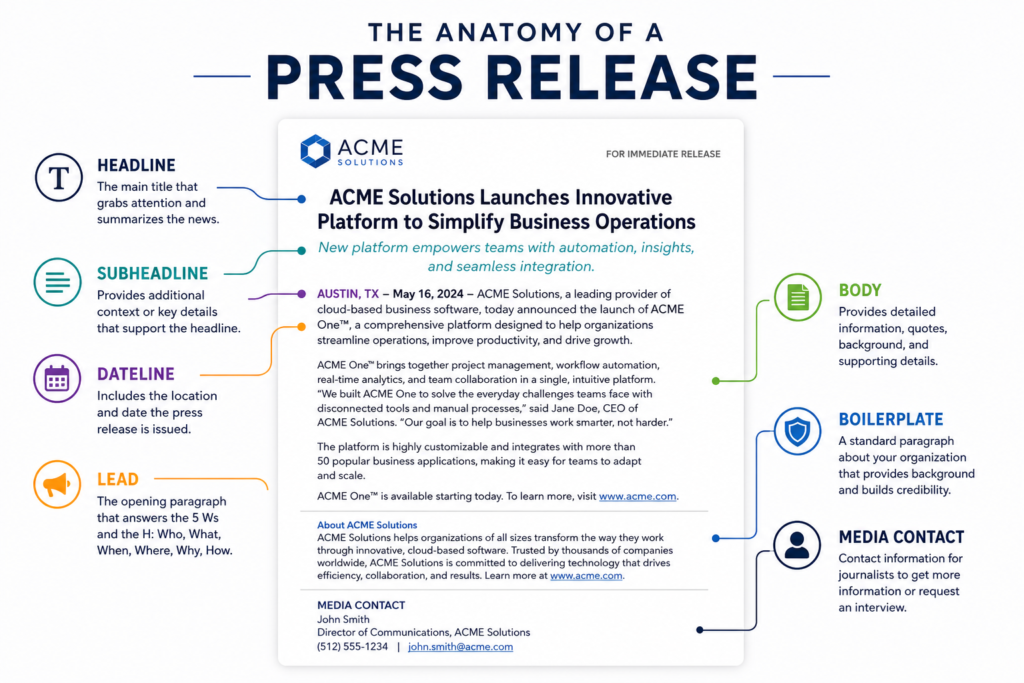
The 7 Core Parts of a Press Release
- Headline
A clear, specific title that communicates the main news. - Subheadline
An optional supporting line that adds context or value. - Dateline
The city and date of the announcement. - Lead Paragraph
The first paragraph that summarizes the main news and why it matters. - Body Paragraphs
Additional details, supporting facts, quotes, data, background, and context. - Boilerplate
A short “About the Company” section. - Media Contact Information
The name, email, and phone number for follow-up.
Simple Press Release Template
| Section | What to Include |
|---|---|
| Headline | Clear news angle |
| Subheadline | Optional added context |
| Dateline | City, state/country, date |
| Lead | Summary of the announcement |
| Body | Details, quotes, facts, impact |
| Boilerplate | Company overview |
| Contact | Media or company contact info |
How to Write a Press Release That Actually Works
Many press releases fail for one reason: they read like marketing copy instead of news. The best releases are clear, direct, and factual.
Best Practices
Lead With the News
Do not bury the main announcement under fluff. Say what happened immediately.
Write for Humans First
Avoid jargon, inflated claims, and technical wording unless your audience truly expects it.
Keep the Tone Professional
A press release should be confident, not hyped. Credibility comes from clarity.
Use Quotes Carefully
A quote should add perspective or interpretation, not repeat the headline.
Include Specifics
Dates, figures, locations, use cases, and outcomes make a release more believable.
Add Distribution Intent
A release should be written with publication in mind. That means formatting, readability, and editorial quality matter.
This is where many businesses benefit from using PR Publishing. Instead of drafting something overly promotional and hoping it works, clients can rely on expert writers who craft journalist-style press releases designed for real publication. That saves time, improves quality, and significantly increases the chance of a credible outcome.
What Makes an IT Press Release Different?
An IT press release is a press release focused on information technology, software, cybersecurity, SaaS, cloud infrastructure, AI, enterprise systems, developer tools, or other tech-related updates.
The structure is similar to any other release, but the messaging requirements are different.
Common IT Press Release Topics
- software launches
- SaaS updates
- cybersecurity announcements
- API or platform releases
- cloud migrations
- enterprise partnerships
- infrastructure upgrades
- AI feature rollouts
- data compliance improvements
- funding rounds for tech companies
How an IT Press Release Differs From a General Press Release
| Element | General Press Release | IT Press Release |
|---|---|---|
| Language | Broad, consumer-friendly | More technical but still clear |
| Audience | Media, public, customers | Tech media, investors, buyers, developers |
| Proof points | Milestones, growth, events | Performance, security, integrations, functionality |
| Quotes | Brand or executive perspective | Often includes product, engineering, or customer use-case insight |
| Risk | Too generic | Too technical |
The Key to a Strong IT Press Release
An IT press release should simplify complexity without losing precision. That means:
- defining the technical update clearly
- explaining the business outcome
- avoiding unnecessary jargon
- showing real-world relevance
For example, “released a new containerized orchestration layer” is incomplete on its own. Better: “released a new container orchestration feature that helps enterprise teams deploy applications faster and reduce infrastructure downtime.”
That translation layer is critical, and it is another area where expert PR writing makes a measurable difference.
Press Release vs Blog Post vs Ad vs Pitch
A lot of confusion comes from mixing formats. Here is the difference.
| Format | Main Goal | Style | Best Use |
|---|---|---|---|
| Press release | Announce news | Factual, structured, media-ready | Launches, milestones, funding, official updates |
| Blog post | Educate or persuade | Conversational, SEO-driven | Thought leadership, how-tos, explainers |
| Advertisement | Drive immediate conversion | Promotional | Sales campaigns, offers |
| Media pitch | Get journalist attention | Personalized, brief | Outreach to reporters |
A press release can support all of these, but it is not a substitute for all of them.
The SEO Benefits of Press Releases
A press release is not magic SEO on its own, but it can play a useful role in a larger visibility strategy.
SEO Advantages
- strengthens branded search results
- creates indexable content tied to key announcements
- supports entity recognition for your company and leadership
- generates content you can repurpose into blog posts and social assets
- can earn backlinks through guest posts, syndication, or pickup coverage
- improves trust signals when users search your brand
A Smarter Way to Use Press Releases for SEO
The smartest businesses do not treat press releases as isolated assets. They pair them with:
- guest posting
- homepage mention or newsroom archives
- founder LinkedIn amplification
- blog expansion pieces
- supporting landing pages
- strategic backlinks
This integrated model is one of the strongest reasons brands use PR Publishing. Beyond distribution, the business value includes SEO benefits through guest posts and backlinks, broad media distribution, and live links reporting so clients can see exactly what was published.
Common Press Release Mistakes to Avoid
Even a good story can fail if the execution is weak.
Top Mistakes
- sounding like an ad
- using a vague headline
- burying the main news
- making claims without evidence
- overloading the release with jargon
- forgetting contact details
- targeting the wrong audience
- distributing before the story is publication-ready
- expecting results from low-quality syndication alone
The Biggest Strategic Mistake
The most expensive mistake is not poor writing. It is poor placement.
A press release only creates business value when it reaches relevant audiences through credible channels. That is why guaranteed placement matters. PR Publishing solves this with publication on high-authority news websites, clear package-based pricing, and a satisfaction guarantee with full refund if publishing promises are not met.
How Long Should a Press Release Be?
Most effective press releases fall between 300 and 700 words. Long enough to explain the story, short enough to stay readable.
Ideal Length by Use Case
| Use Case | Recommended Length |
|---|---|
| Product launch | 400–650 words |
| Funding announcement | 350–600 words |
| Event announcement | 300–500 words |
| IT press release | 450–750 words |
| Crisis response | 300–550 words |
If your story needs more detail, use the press release as the formal announcement and create a separate blog post or newsroom article for deeper explanation.
How Press Release Distribution Works
Writing the release is only the first half. Distribution determines whether it gets seen.
Basic Distribution Options
- publish it on your own website
- send it directly to journalists
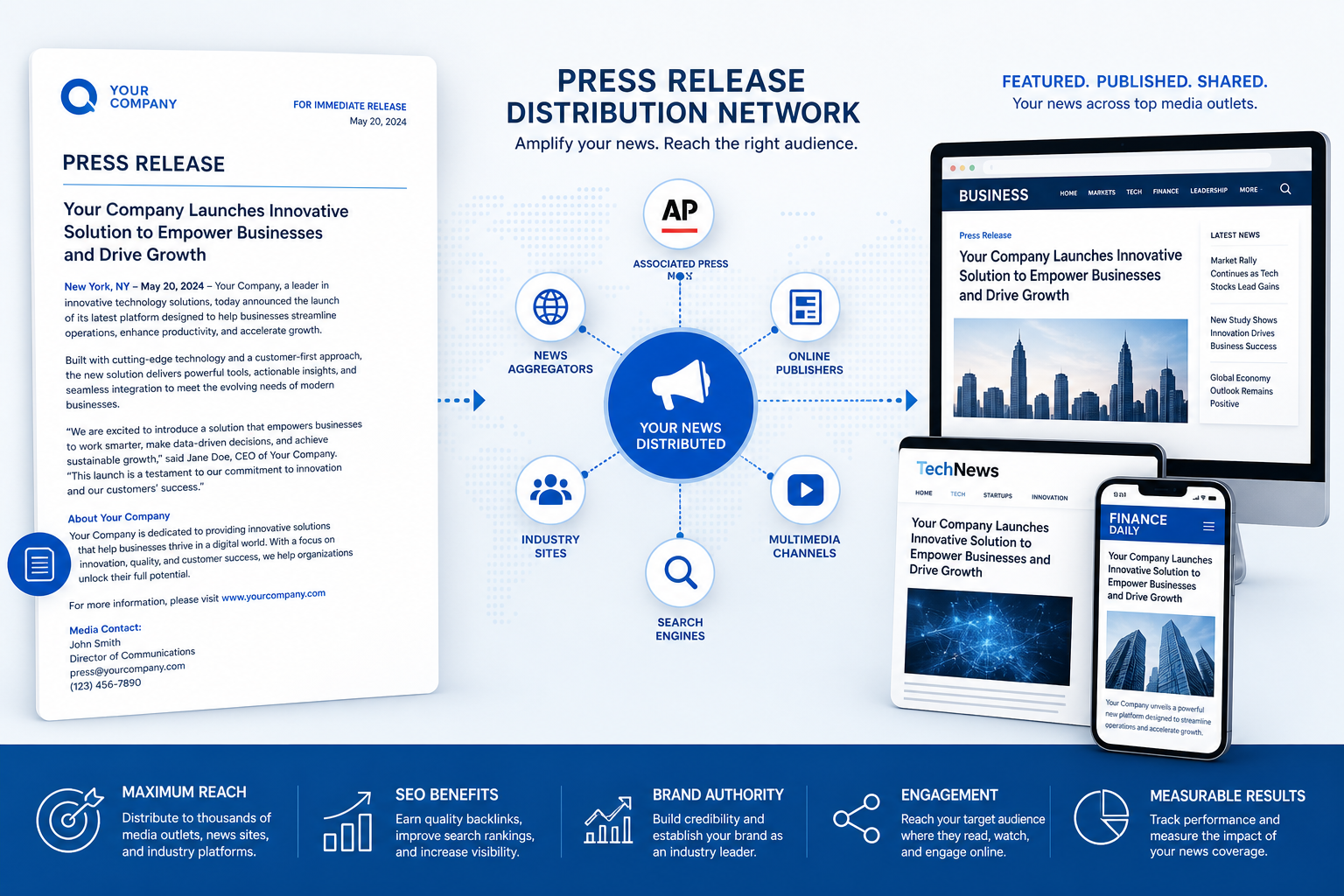
- use a press release distribution network
- secure publication through PR/media partners
- combine distribution with guest posting and authority placements
Why Businesses Choose Done-for-You Distribution
Most founders and marketing teams do not want to spend days researching editorial requirements, formatting releases, pitching outlets, following up, and tracking links. They want speed, predictability, and outcomes.
That is why PR Publishing is built around a simple execution model:
- submit your business details
- get a professionally written or refined press release
- publish across a media network
- receive live publication links
- scale up as needed from startup to enterprise
For businesses that need fast credibility without hiring a traditional PR agency, this is a practical advantage.
How to Know if Your Press Release Is Worth Publishing
Before you distribute anything, ask these questions:
Quick Qualification Checklist
- Is this new?
- Is this relevant to a real audience?
- Is the value clear in one sentence?
- Can I explain why it matters now?
- Would a customer, investor, or journalist find this credible?
- Do I have proof, specifics, or context to support it?
If the answer is yes, you likely have a viable press release.
A Beginner-Friendly Press Release Example
Example Headline
Acme Cloud Launches AI-Powered Security Monitoring Platform for Mid-Market SaaS Teams
Example Lead
Austin, Texas – May 8, 2026 – Acme Cloud today announced the launch of its AI-powered security monitoring platform designed to help mid-market SaaS companies detect threats faster, reduce alert fatigue, and improve compliance visibility across cloud environments.
Why It Works
- clear who and what
- immediate business context
- specific audience
- visible benefit
- professional tone
That is the level of clarity businesses should aim for.
Why Professional Press Release Writing Pays Off
Beginners often underestimate how much wording affects outcomes. A sloppy release can make a legitimate company look unprepared. A polished release can make a growing brand look established and trustworthy.
What Professional Writing Improves
- sharper headlines
- better structure
- stronger news angle
- clearer quotes
- cleaner formatting
- more publication-ready language
- easier journalist pickup
- stronger credibility with readers
This is one of the clearest reasons to use PR Publishing. Clients get professional press release writing by expert writers, fast turnaround, transparent pricing with no hidden fees, and scalable packages whether they are a startup announcing a launch or an enterprise promoting multiple campaigns.
Final Verdict: Why Press Releases Matter More Than Most Businesses Realize
A press release is more than a formal announcement. It is a credibility asset, a visibility tool, and a business growth lever when used correctly.
For beginners, the key takeaway is simple:
- a press release is a factual company announcement
- press release news release usually means the same thing as press release
- press release news often refers to publicly distributed or published company news
- an IT press release follows the same format but requires more technical clarity and stronger business translation
If your company needs fast exposure, stronger online authority, better branded search presence, and visible proof of legitimacy, a professional press release strategy can deliver outsized value.
And if you want the shortest path from announcement to publication, PR Publishing offers a compelling solution: guaranteed publication on high-authority news websites, expert writing, fast 24–72 hour turnaround, live link reporting, transparent pricing, revision support, and a refund guarantee if delivery promises are not met.
For startups, founders, small businesses, and scaling brands, that means less guesswork and more measurable credibility.
FAQ
What is a press release and why is it important?
A press release is a structured, factual announcement used to share news about a company, product, event, or milestone. It is important because it helps businesses build credibility, visibility, media exposure, and trust with customers, investors, and journalists.
What are the 4 C’s of journalism?
The 4 C’s are commonly understood as clear, concise, correct, and compelling. These principles matter in press releases because they make information easier for journalists and readers to understand and trust.
What are the 5 W’s in a press release?
The 5 W’s are who, what, where, when, and why. A strong press release should answer all five clearly, along with how, so the audience immediately understands the full story.
What are the 7 parts of a press release?
The 7 main parts are the headline, subheadline, dateline, lead paragraph, body, boilerplate, and media contact information. Together, these elements create a format that is easy to scan, publish, and repurpose.
What are the 7 parts of a press release?
A standard press release includes a headline, subheadline, dateline, lead, supporting body paragraphs, company boilerplate, and contact details. This structure helps deliver the news quickly and professionally.
What are the 4 C’s of journalism?
In practical writing, the 4 C’s mean your content should be clear, concise, correct, and credible. For press releases, these qualities improve readability, accuracy, and the likelihood of publication.