
AI SEO: 15 Best AI SEO Tools to Boost Your Rankings in 2026
Search has changed more in the last two years than in the previous ten. Google AI Overviews, ChatGPT, Perplexity, and other AI-powered search experiences are changing how people discover information, compare products, and find businesses. Ranking in the traditional search results still matters, but visibility increasingly depends on whether your content can be understood, trusted, and referenced by AI systems.
This is where AI SEO comes in. By combining artificial intelligence with traditional search engine optimization, businesses can speed up keyword research, content planning, competitor analysis, technical audits, and optimization. The right AI SEO tools can also help identify content gaps and improve your chances of appearing in AI-generated answers.
In this guide, we’ll explain what is AI SEO, how it works, how it differs from traditional SEO, and how to choose the right tools. We’ll also look at 15 AI SEO tools worth considering in 2026.
What Is AI SEO? Understanding AI Search Optimization
What Is AI SEO and Why Does It Matter?
AI SEO refers to using artificial intelligence, machine learning, and natural language processing to improve and automate different SEO tasks. Instead of relying entirely on manual research, marketers can use AI to analyze search results, identify patterns, organize keywords, optimize content, and discover new opportunities.
The rise of AI-powered search makes this approach increasingly important. Search platforms are becoming better at understanding context, meaning, and user intent rather than simply matching keywords. Businesses therefore need content that answers questions clearly and demonstrates genuine expertise.
For companies investing in AI SEO services, the goal isn’t simply to automate SEO. It’s to use technology to make better decisions while keeping human expertise at the center of the process.
How Does AI SEO Work?
So, how does AI SEO work in practice? AI tools process large amounts of search data, SERP patterns, competitor information, and content signals to identify opportunities and problems.
Depending on the platform, an AI SEO workflow can help you:
- Discover relevant keywords and long-tail queries
- Group keywords according to search intent
- Analyze competing pages
- Identify content gaps and missing subtopics
- Optimize headings, structure, and semantic coverage
- Find technical SEO issues
- Suggest internal linking opportunities
- Monitor search visibility and AI mentions
Instead of spending hours sorting through spreadsheets and search results, marketers can turn large amounts of data into practical recommendations.
How AI-Powered Search Is Changing SEO
AI-powered search is changing the definition of visibility. Google AI Overviews and conversational platforms can answer questions directly, sometimes reducing the need for users to click through several traditional search results.
That means the goal is no longer limited to ranking on page one. Brands also want their content to become a reliable source for AI-generated answers.
Clear structure, original information, strong topical authority, accurate facts, and useful explanations can make content easier for AI systems to understand and reference. This shift is one reason AI search optimization has become an important part of modern SEO.
AI SEO vs Traditional SEO: What Has Changed?
Key Differences Between AI SEO and Traditional SEO
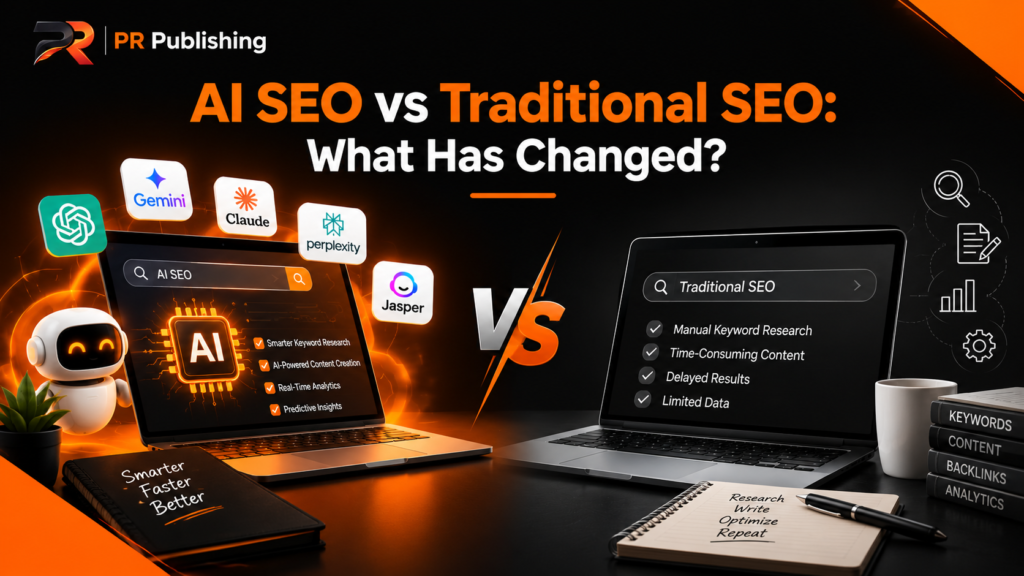
Traditional SEO has historically focused on keywords, backlinks, technical optimization, and improving organic rankings. These fundamentals still matter, but AI SEO vs traditional SEO is increasingly about how technology changes the optimization process and how content is discovered.
AI SEO adds automation, predictive insights, semantic analysis, and optimization for AI-driven search experiences. Instead of focusing only on individual keywords, marketers can build content around topics, entities, relationships, and search intent.
| Traditional SEO | AI SEO |
| Manual keyword research | AI-assisted keyword discovery |
| Keyword-focused optimization | Context and semantic optimization |
| Traditional SERP rankings | Rankings plus AI visibility |
| Manual competitor analysis | Automated competitor insights |
| Individual keywords | Topics and search intent |
| Periodic audits | Faster, automated analysis |
The two approaches are not competitors. Modern websites can use traditional SEO fundamentals together with AI-assisted workflows.
How Search Intent Influences AI SEO
Search intent is one of the most important elements of an effective AI SEO strategy. A person searching for “what is AI SEO” has a different need from someone searching for “best AI SEO tools” or “AI SEO services.”
AI systems analyze language and context to understand whether someone wants to:
- Learn something
- Compare options
- Solve a problem
- Find a product or service
- Complete a specific task
AI SEO tools can analyze search results to identify these patterns and help you choose the right content format, depth, and tone. A page that matches the keyword but fails to satisfy the underlying intent may struggle to earn meaningful visibility.
Why Semantic SEO Matters for AI Search
Semantic SEO focuses on meaning, relationships, entities, and context rather than repeatedly using an exact keyword. This approach is particularly useful for AI search because modern search systems can understand connections between concepts.
For example, an article about AI SEO may naturally discuss artificial intelligence in SEO, search intent, AI search optimization, generative engine optimization, semantic SEO, topical authority, and AI visibility.
Structured headings, descriptive internal links, relevant entities, and schema markup can also help search engines understand how different pieces of information relate to one another.
Together, these signals create a more complete topical picture instead of treating a page as a collection of isolated keywords.
Why AI SEO Tools Matter for Modern Search
How AI SEO Tools Improve Keyword Research
AI SEO tools can make keyword research faster and more practical. Instead of looking only at search volume, modern platforms can help group related queries according to intent, identify long-tail opportunities, and uncover content gaps.
This makes it easier to build a keyword strategy around realistic opportunities rather than chasing every high-volume term.
For example, a website targeting “AI SEO” could build supporting content around:
- What is AI SEO?
- How does AI SEO work?
- AI SEO vs traditional SEO
- AI SEO tools
- How to optimize for AI search
- AI SEO vs GEO
The result is a broader content strategy that supports both individual pages and overall topical authority.
Using AI Tools to Build Topical Authority
Topical authority comes from demonstrating meaningful coverage of a subject rather than publishing one article and moving on.
AI tools can help identify missing subtopics, suggest related questions, organize topic clusters, and find opportunities for internal linking. This makes it easier to create a connected content ecosystem.
For example, a website covering AI SEO could create a pillar page supported by articles about AI search optimization, generative engine optimization, answer engine optimization, LLM optimization, AI SEO tools, and search intent.
The technology helps with planning, but the quality of the information still determines whether the content is genuinely useful.
How AI SEO Tools Can Improve AI Visibility
Search visibility now extends beyond traditional blue links. Some newer platforms can monitor how brands and pages appear across AI-powered search experiences, including Google AI Overviews, ChatGPT, and Perplexity.
These insights can help identify:
- Which pages are being referenced
- Which topics generate brand mentions
- Where competitors receive visibility
- Which questions your content doesn’t answer
- Where content needs stronger evidence or clarity
Improving AI visibility requires more than adding keywords. Content needs to be accurate, useful, well-structured, and supported by credible information.
What to Look for in the Best AI SEO Tools
AI Search Optimization Features
If AI search is part of your strategy, look for platforms that provide AI visibility or citation monitoring. These features can show how your brand appears across AI-powered search experiences and where competitors may have stronger visibility.
Keyword Research and Search Intent Analysis
A useful platform should help you understand both keywords and the intent behind them. Look for keyword clustering, long-tail suggestions, difficulty analysis, and search-intent insights.
The objective is not simply to find keywords with large search volumes. It is to find queries that match your audience, content capabilities, and business goals.
Content Optimization and Semantic SEO
Strong content optimization tools analyze your draft against relevant search results and identify related terms, entities, questions, and subtopics.
These recommendations can improve topical coverage without forcing unnatural keyword repetition. The best workflow still leaves room for human editing, because useful content should sound natural rather than mechanically optimized.
Competitor and SERP Analysis
Competitor analysis helps reveal what successful pages are doing well. Depending on the tool, you may be able to analyze content depth, keyword coverage, backlinks, SERP features, and content gaps.
Use this information as research rather than copying competitors. Your content should add something useful that existing results don’t provide.
AI-Powered Content and Technical SEO Features
Many modern platforms combine content features with technical SEO capabilities. Depending on the product, these can include AI-assisted writing, website audits, schema recommendations, internal linking, and performance checks.
Automation can save time, but recommendations should always be reviewed before implementation. AI can identify an opportunity, while human judgment determines whether the suggested change actually makes sense for the website.
15 Best AI SEO Tools to Try in 2026
1. ChatGPT for AI SEO and Content Optimization
ChatGPT can support many parts of an SEO workflow, including brainstorming, keyword research assistance, content outlines, editing, FAQs, and content refinement. It can also help turn complex SEO information into clearer explanations.
For marketers using AI SEO for ChatGPT, the important point is that the tool can assist with the work, but human review remains essential for accuracy, originality, and brand voice.
2. Semrush for AI SEO Strategy and Keyword Research
Semrush is a broad SEO platform covering keyword research, competitor analysis, content optimization, technical SEO, and visibility tracking.
For an AI SEO strategy, it can help marketers move from keyword discovery to content planning and performance analysis within one ecosystem.
3. Ahrefs for Search Intent and Competitor Analysis
Ahrefs is widely used for analyzing organic keywords, backlinks, competing pages, and search opportunities.
Its data can help marketers understand what competitors rank for and identify opportunities that may otherwise be difficult to spot. It is particularly useful when building content around search intent and competitor gaps.
4. Surfer SEO for Semantic SEO and Content Optimization
Surfer SEO focuses heavily on content optimization using SERP data. It can help writers identify relevant terms, topics, and content characteristics associated with ranking pages.
For websites working on semantic SEO, this type of guidance can help improve topical coverage while keeping the writing focused on the user’s query.
5. SE Ranking for AI-Powered SEO Analysis
SE Ranking brings together keyword research, rank tracking, website auditing, competitor analysis, and other SEO capabilities.
Its combination of traditional SEO data and newer AI-search features can help businesses monitor both organic performance and emerging search visibility opportunities.
6. Frase for AI-Generated Answers and Content Optimization
Frase is designed around content research and optimization. It can help analyze search results, build content briefs, identify relevant topics, and improve drafts.
It is useful for teams that want to understand what information should be covered before producing an article rather than relying on AI-generated text alone.
7. Scalenut for AI SEO Content Strategy
Scalenut combines keyword research, topic planning, content optimization, and AI-assisted content workflows.
For publishers producing content at scale, it can help organize related keywords and develop a more structured content strategy. The strongest results still come from reviewing and improving AI-assisted output before publication.
8. Jasper for AI Content and SEO Workflows
Jasper is primarily known as an AI content and marketing platform. It can support content creation and optimization workflows while helping marketing teams maintain consistent messaging.
For businesses using AI SEO services, tools like Jasper can become part of a broader workflow where AI handles repetitive tasks while strategists manage direction and quality.
9. Alli AI for Automated AI SEO Optimization
Alli AI focuses heavily on automating SEO changes. Depending on the website and setup, it can assist with technical and on-page optimization across multiple pages.
Automation can be particularly useful for larger websites where manually implementing repetitive SEO improvements would take significant time.
10. MarketMuse for Topical Authority and Content Planning
MarketMuse focuses on content intelligence, topic research, competitive analysis, and content planning.
It can help identify content gaps and determine how thoroughly a website covers a particular subject. This makes it useful for businesses working to strengthen topical authority rather than targeting isolated keywords.
11. NeuronWriter for Semantic SEO Optimization
NeuronWriter provides content optimization recommendations based on competing pages and semantic terms.
It can help writers identify related concepts that should be included in an article, making it easier to create content that covers a subject comprehensively instead of relying on repetitive exact-match keywords.
12. Outranking for AI SEO Content Strategy
Outranking combines SEO research, content planning, optimization, and AI-assisted workflows.
It can help marketers move from keyword research toward structured content production. Like other AI platforms, its recommendations work best when reviewed against the actual needs of the audience.
13. Rank Math for AI SEO and WordPress Optimization
Rank Math is a WordPress SEO plugin that combines traditional optimization features with AI-assisted capabilities.
It can help WordPress users manage on-page SEO, structured data, content analysis, and other optimization tasks directly from their websites.
14. Yoast SEO for AI-Assisted Content Optimization
Yoast SEO provides SEO analysis, readability guidance, and optimization features for WordPress websites and other supported platforms.
Its straightforward approach makes it useful for publishers who want practical on-page guidance while maintaining control over their content.
15. Clearscope for Search Intent and Content Optimization
Clearscope focuses on content optimization and helping writers understand the topics and terms associated with search results.
It can be particularly useful for teams that already have a content strategy and want additional guidance on topical coverage, relevance, and search intent.
How to Optimize for AI Search in 2026
How to Optimize Content for AI-Generated Answers
If you want to understand how to optimize for AI search, start with the basics: answer questions clearly and provide useful supporting information.
Lead sections with direct answers, use descriptive headings, define important terms, and support claims with credible sources. Original examples, statistics, and first-hand insights can also make content more useful.
Instead of writing solely for an algorithm, structure the page so a reader can quickly find the information they need.
How to Improve AI Visibility Across Search Platforms
Don’t focus exclusively on Google. AI-powered search experiences are becoming another discovery channel, so monitor how your brand and content appear across platforms such as ChatGPT, Perplexity, and Google AI Overviews.
Consistent brand information, expert commentary, digital PR, credible third-party mentions, and high-quality content can all contribute to a stronger online presence.
Using Structured Content for AI-Powered Search
Clear structure makes information easier for both users and search systems to understand.
Use:
- Descriptive H2 and H3 headings
- Short, focused paragraphs
- Bullet points where appropriate
- Tables for genuine comparisons
- FAQ sections
- Descriptive internal links
- Relevant schema markup
Well-organized pages make it easier to identify individual facts and answers without making the article feel overly technical.
Building Topical Authority for AI Search
Building topical authority requires consistent coverage of a subject. Start with a strong pillar page, then create supporting articles that answer related questions and connect them through relevant internal links.
Update older content when facts change, include credible sources, and demonstrate real expertise. A website that consistently provides useful information around a subject gives both readers and search systems stronger signals about its relevance.
AI SEO for ChatGPT, Google AI Overviews, and Perplexity
AI SEO for ChatGPT Search
AI SEO for ChatGPT involves creating content that is clear, authoritative, current, and useful enough to be considered a relevant source.
ChatGPT Search can retrieve information from the web and provide citations. This makes traditional SEO fundamentals, accurate information, clear structure, and credible external references important parts of the broader strategy.
AI SEO for Google AI Overviews
AI SEO for Google AI Overviews starts with strong traditional SEO. Pages need to be crawlable, indexable, useful, and relevant to the query.
Helpful content, logical structure, fast performance, internal linking, and appropriate structured data can support search visibility. Rather than creating separate content only for AI Overviews, focus on producing pages that comprehensively satisfy the underlying search intent.
AI SEO for Perplexity
AI SEO for Perplexity similarly benefits from accurate and well-supported information. Perplexity presents citations alongside answers, making source quality and clarity particularly important.
Pages containing useful statistics, clear explanations, recent information, and credible references can provide stronger material for AI systems to interpret and cite.
How AI Search Platforms Select Information
Different AI search platforms use different systems and ranking processes, so there is no single formula that guarantees inclusion.
However, relevance, authority, freshness, clarity, and source quality are recurring considerations. AI systems retrieve information, interpret passages, and may cite sources that provide useful evidence for an answer.
That is why creating trustworthy content remains more important than trying to manipulate individual AI systems.
AI SEO vs GEO: Understanding Generative Search
What Is Generative Engine Optimization?
Generative Engine Optimization, commonly called GEO, focuses on improving the chances that content, brands, or sources are mentioned in AI-generated responses.
Instead of focusing exclusively on traditional ranking positions, GEO considers how generative engines retrieve, interpret, summarize, and cite information.
AI SEO vs GEO: Key Differences
The concepts overlap, but they are not exactly the same.
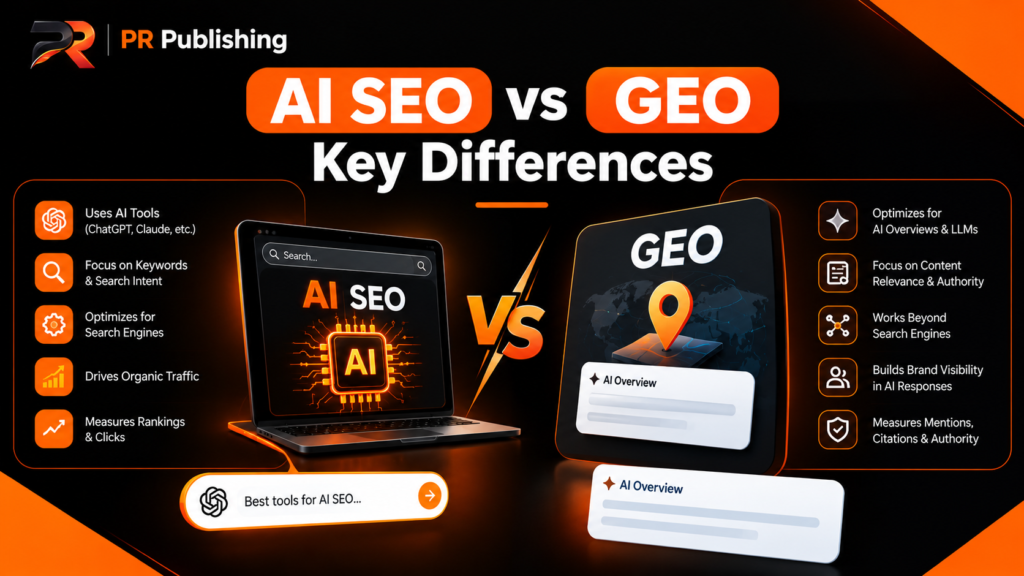
AI SEO can refer to using artificial intelligence to improve SEO research, content optimization, technical analysis, and search visibility. GEO is more specifically concerned with visibility inside generative AI responses.
| AI SEO | GEO |
| Improves SEO workflows with AI | Focuses on generative search visibility |
| Includes keyword and content research | Focuses on AI-generated responses |
| Supports technical SEO | Emphasizes citations and mentions |
| Can target traditional search | Primarily targets generative engines |
In practice, businesses can use both approaches as part of a broader search strategy.
How Generative Engine Optimization Supports AI Visibility
Generative engine optimization can support AI visibility by making important information easier for AI systems to discover and understand.
Clear explanations, original research, structured pages, consistent brand information, and credible third-party references can all help establish stronger signals around a brand or topic.
The objective should be to become a useful source of information rather than simply trying to force a mention.
AI SEO, AEO, and LLM Optimization Explained
What Is Answer Engine Optimization?
Answer Engine Optimization, or AEO, focuses on helping content become a direct answer to user questions.
It can involve optimizing for featured snippets, voice search, AI-generated summaries, and other answer-focused search experiences. Question-based headings, concise answers, FAQs, structured content, and relevant schema can make information easier to interpret.
What Is LLM Optimization?
LLM optimization focuses on making information easier for large language models to understand, associate with a brand or entity, and reference accurately.
This can include maintaining consistent information across trusted sources, publishing original research, earning credible mentions, and explaining complex subjects clearly.
The goal isn’t simply to insert more keywords. It is to build a strong, consistent information footprint that accurately represents the subject or brand.
AI SEO vs AEO vs GEO
These terms describe overlapping areas of modern search optimization.
- AI SEO: Uses AI to support SEO research, optimization, and strategy.
- AEO: Focuses on providing direct answers to questions.
- GEO: Focuses on visibility within generative AI responses.
- LLM optimization: Focuses on making information easier for language models to understand and reference.
A modern SEO strategy may use elements of all four rather than treating them as completely separate disciplines.
How LLM Optimization Can Improve AI Visibility
Effective LLM optimization starts with accurate and consistent information. Regularly review how your brand or subject is represented online, update outdated facts, strengthen credible references, and publish useful original material.
Over time, this can create a stronger information footprint that helps AI systems understand your expertise and represent it more accurately.
AI SEO Best Practices for Better Search Visibility
Create Helpful Content Based on Search Intent
Start with search intent. Before writing an article, determine what the searcher actually wants to accomplish.
Is the user looking for an explanation, comparison, tutorial, product, or service? Once you understand the intent, match the content format, depth, and tone to that need.
Build Strong Topical Authority
Don’t rely on one page to rank for every variation of a topic. Build connected content that covers the subject from different angles.
For example, a website targeting AI SEO can publish supporting content around AI SEO tools, AI search optimization, GEO, AEO, LLM optimization, AI-generated answers, and technical SEO.
Use Semantic SEO and Related Topics
Use natural variations, related entities, and supporting concepts instead of repeating the same keyword in every paragraph.
Semantic SEO helps create context. When related ideas are explained naturally, search engines can better understand what the page covers and how its information connects.
Optimize Content for AI-Generated Answers
Make important information easy to extract and understand. Use direct answers, descriptive headings, short paragraphs, lists, definitions, and supporting evidence.
Don’t sacrifice readability just to make content easier for machines. The page should first make sense to a human reader.
Strengthen Internal Linking and Website Structure
Connect related articles using descriptive anchor text and maintain a logical site hierarchy.
For example, an article about AI SEO tools could link naturally to separate guides about keyword research, semantic SEO, AI search optimization, and GEO.
Strong internal linking helps readers discover related information while giving search engines additional context about your website.
Keep AI-Assisted Content Accurate and Original
AI can accelerate content production, but every draft should be reviewed by a human.
Check facts, remove repetitive language, add original insights, and make sure the final article reflects genuine expertise. AI-assisted content becomes much more valuable when human experience and editorial judgment shape the final version.
How to Build an Effective AI SEO Strategy
Start With Keyword Research and Search Intent
An effective AI SEO strategy starts with understanding your audience.
Identify the questions people ask, group related keywords, and determine the intent behind each topic. AI SEO tools can speed up this process, but keyword selection should still reflect your actual audience and business goals.
Create Topic Clusters and Build Topical Authority
Organize related topics around pillar pages and supporting articles.
For example, an AI SEO pillar page can connect to content about AI SEO tools, AI search optimization, generative engine optimization, answer engine optimization, and LLM optimization.
Use internal links to connect these pages naturally and create a clear topical structure.
Optimize Existing Content for AI Search
Don’t always start from scratch. Older content may already have authority but lack important information.
Audit existing pages for:
- Outdated facts
- Missing subtopics
- Weak answers
- Poor headings
- Missing FAQs
- Limited internal links
- Lack of structured data
Refreshing these pages can be more efficient than constantly publishing new content.
Monitor AI Visibility and Organic Search Performance
Track traditional SEO metrics such as rankings, organic traffic, and conversions alongside emerging AI visibility signals.
Monitor whether your brand appears in ChatGPT, Perplexity, and Google AI Overviews where relevant. Review which topics and pages receive attention, then use those findings to improve future content.
Combine AI SEO Tools With Human Expertise
The most effective workflow isn’t AI versus humans. It’s AI plus human judgment.
Let AI handle repetitive research, keyword clustering, data organization, and initial drafts. Let people handle strategy, fact-checking, editorial decisions, first-hand experience, and originality.
That combination keeps the process efficient without making the final content feel automated.
Can AI SEO Tools Improve Google Rankings?
What AI SEO Tools Can Help You Do
AI SEO tools can support almost every stage of the optimization process. They can uncover keyword opportunities, analyze competitors, identify content gaps, review drafts, find technical issues, and suggest internal links.
For businesses using AI SEO services or working with an AI SEO agency, these capabilities can reduce repetitive work and give teams more time to focus on strategy and quality.
However, tools should support SEO decisions rather than make every decision automatically.
Why AI Tools Alone Cannot Guarantee Rankings
No AI SEO tool can guarantee a specific Google ranking.
Search performance depends on many factors, including relevance, content quality, website authority, competition, backlinks, technical health, user experience, and other signals.
AI recommendations are also based on available data and assumptions. Following a tool’s score blindly can lead to generic or over-optimized content.
The Importance of Quality, Relevance, and Search Intent
The foundation remains simple: create content that genuinely satisfies the person behind the search.
Focus on accuracy, originality, relevance, and search intent first. Then use AI SEO tools to make the process faster, identify gaps, and improve the content.
Technology can increase efficiency, but useful information is what creates long-term value.
Frequently Asked Questions About AI SEO
What Is AI SEO and How Does It Improve Search Rankings?
AI SEO uses artificial intelligence to support SEO activities such as keyword research, content optimization, competitor analysis, and technical audits. It can help identify opportunities and improve content relevance, but rankings still depend on overall quality, authority, relevance, and competition.
What Are the Best AI SEO Tools for Better Rankings in 2026?
Popular AI SEO tools include Semrush, Ahrefs, Surfer SEO, SE Ranking, Frase, Scalenut, MarketMuse, and Clearscope. The right choice depends on whether you need keyword research, content optimization, technical SEO, competitor analysis, or AI-search visibility.
How Does AI SEO Work to Improve Content Optimization?
AI tools analyze search results, competitors, keywords, related topics, and search intent to identify potential improvements. They can recommend changes to structure, topical coverage, keywords, internal links, and technical elements.
How Can You Optimize for AI SEO and AI Search in 2026?
To optimize for AI search, create clear, authoritative, well-structured content that directly answers user questions. Use descriptive headings, relevant entities, internal links, structured data, credible sources, and original insights. Also monitor how your content appears across emerging AI search platforms.
What Is the Difference Between AI SEO and GEO Optimization?
AI SEO uses artificial intelligence to support SEO research and optimization, while GEO focuses specifically on visibility within generative AI responses. The two approaches overlap and can work together as part of a broader search strategy.
Final Thoughts on AI SEO and AI Search Optimization
Search will continue to evolve, but one thing remains consistent: people want useful, trustworthy answers from sources they can rely on. AI SEO gives businesses new ways to research, optimize, and improve their search visibility, while AI search optimization expands that goal beyond traditional rankings.
The best approach is not to rely on automation alone. Use AI SEO tools to uncover opportunities, analyze data, organize content, and speed up repetitive tasks. Then add human expertise, original insights, accurate information, and a genuine understanding of your audience.
Whether you’re working with an AI SEO agency, using AI SEO services, or managing SEO yourself, the fundamentals still matter. Build topical authority, satisfy search intent, use semantic SEO naturally, and create content that deserves to be referenced.